

Jali Screens: From Mughal Courtyards To Modern Facades

Stand before a true stone jali and the wall seems to breathe. Sunlight enters as a drifting lattice of shadow, a breeze passes through, and a pattern carved by hand slowly moves across the floor through the day. For centuries this was one of the quiet luxuries of the Mughal court. Today the same idea is being rediscovered by architects and collectors who want a building to feel crafted rather than manufactured.
This article follows the jali from the courtyards of the Mughal emperors to the modern facade, and explains why a hand-carved jali is rare, and why it is meant for the few who look for art form.
What is a jali?
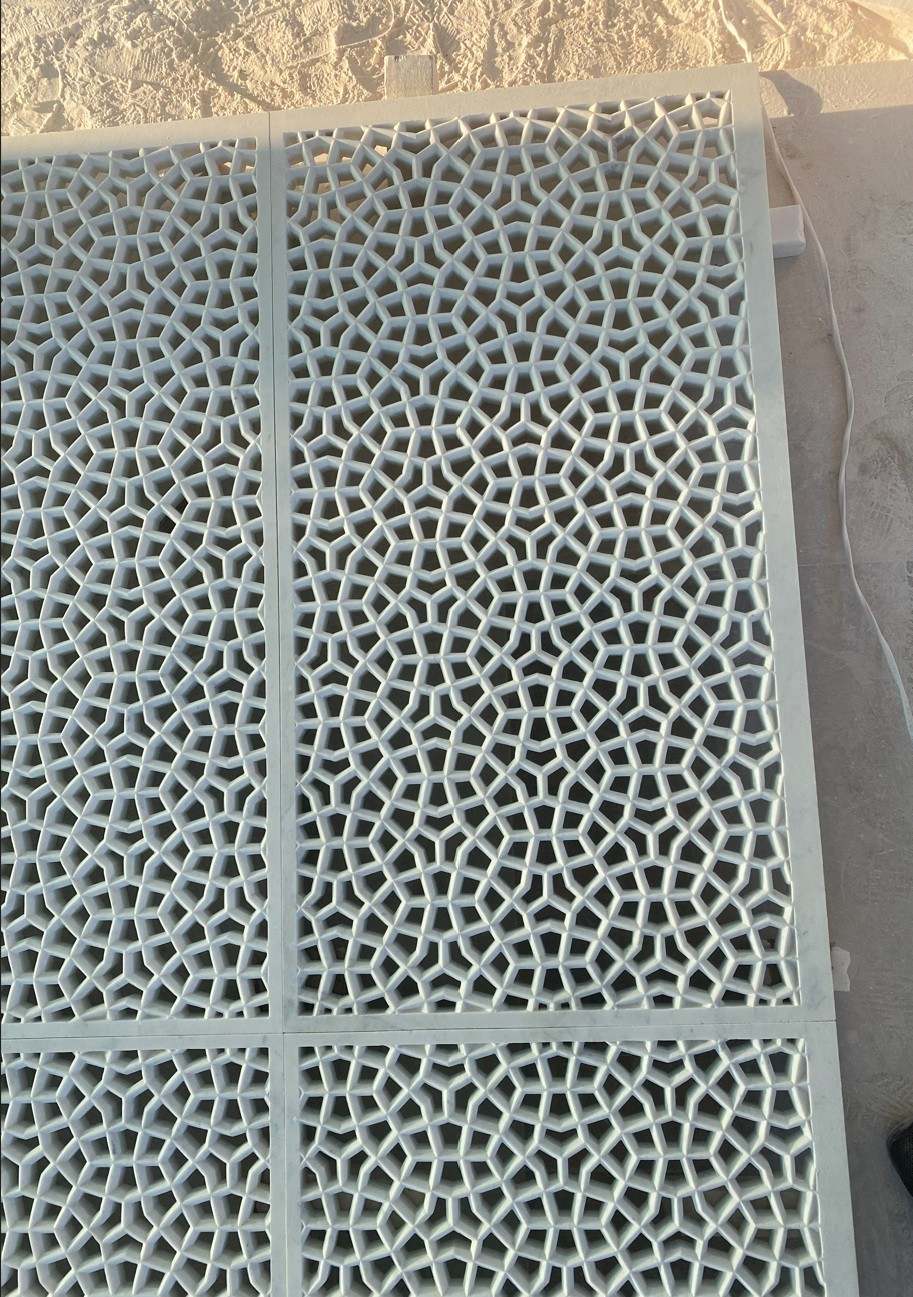
The word jali (also written jaali) comes from the Hindi and Urdu word for “net”. It describes a pierced screen, most often carved from stone, with a pattern of openings that lets air and light through while giving shade and privacy. A jali is both a wall and a window: it separates spaces without closing them off.
A well-made jali does four things at once:
- Filters light: strong sunlight is softened into a pattern of light and shadow.
- Lets air move: openings allow a breeze to pass, which keeps rooms and courtyards comfortable.
- Gives privacy: people inside can see out more easily than strangers can see in.
- Adds beauty: the pattern itself becomes the architectural statement.
Jali in Mughal architecture
Pierced stone screens were refined into a high art under the Mughal emperors. Marble jali screens surround the cenotaphs inside the Taj Mahal, where the lattice filters daylight onto the white stone. At Fatehpur Sikri, red sandstone screens cast patterned light across courtyards and halls. Further west, the carved windows of the Sidi Saiyyed Mosque in Ahmedabad are celebrated for their flowing, tree-like patterns.
These were not decorations added at the end. The jali was part of how the building was meant to be lived in: cooling, shaded, private and beautiful at the same time.
Geometry and nature
Jali patterns generally follow one of two traditions. Geometric patterns repeat stars, hexagons and interlocking polygons across the screen. Floral and vegetal patterns carve flowering vines and trees into the stone. Both ask the same of the artisan: openings of exact size, and thin stone bridges between them that must remain strong.
How a hand-carved jali is made
Methods vary from workshop to workshop, but the work of a hand-carved marble jali moves through recognisable stages:
- Design: the pattern is drawn to scale so that every opening, bridge and curve is planned.
- Choosing the stone: a slab is selected for soundness and consistent character. The bridges are thin, so the stone must be sound throughout.
- Piercing and carving: the openings are cut and then shaped, and the pattern is carved by hand with chisels and files.
- Refining: edges are worked until the pattern is crisp and every repeat matches.
- Polishing: the screen is finished so that the stone catches light as it was meant to.
Because the finished screen is made of thin stone members, a single mistake late in the work can mean starting again. That is part of why the work is rare.

Hand-carved or machine-cut: why the difference matters
Today a stone screen can also be cut by machine, using water-jet or CNC cutting from a digital file. Machine-cut screens are fast, exact and repeatable, and they have a legitimate place in commercial work where volume and speed matter.
A hand-carved jali is a different kind of object. It is the work of an artisan who has trained for years, who reads the stone as he cuts, and whose judgment shapes every curve. No two hand-carved jalis are ever identical, and none can be reproduced by simply running the file again. For the connoisseur, the difference is like that between a print and an original.
That is why hand-carved jali is rare. It is not made in volume and it is not meant for everyone. It is meant for the few who are looking for an art form, and who understand the value of work that can only be done by hand.
The Plaza Residence jali
One of our signature commissions is The Plaza Residence in New York City. The centrepiece is a hand-carved marble jali screen: a monolithic lattice sculpted by master artisans, and back-lit so that the pattern glows in the living and dining area. It is an Indo-Italian piece, joining the Indian jali tradition with Italian marble.
Back-lighting shows what a hand-carved screen can do. By day it filters daylight. By evening the carved openings and the fine bridges between them are lit from behind, and every cut is visible. See the full project on our Plaza Residence page, or browse the portfolio.
Jali in contemporary architecture
Architects are returning to the jali because it solves modern problems with an old idea. A carved screen can:
- Shade a facade while keeping views and air.
- Divide a room without closing it, as a partition between living and dining spaces.
- Become a feature wall, especially when lit from behind.
- Screen a garden, balcony or entrance with privacy that still lets the space breathe.
Stone is heavy, so the structure, fixings and delivery route are best planned with your architect early. A good maker will work with your drawings from the start.
What to consider before commissioning a jali
- The pattern: geometric and floral designs suit different spaces.
- The stone: marble and sandstone each have their own character.
- The scale: the size of the screen and the thickness of the stone affect handling and installation.
- The light: decide whether the screen will be lit from behind.
Frequently asked questions
What does jali mean?
Jali means “net” in Hindi and Urdu. It refers to a pierced screen, usually of stone, that lets light and air through while giving shade and privacy.
Is a jali structural?
Usually a jali screens or divides a space. It is not normally the structure that holds the building up, so it needs to be supported and fixed properly. Plan this with your architect.
Can a jali be made to my own design?
Yes. The Rockscape Company makes bespoke commissions, so the pattern, stone and scale can be planned around your project. Share your brief through the Inquire page.
How much does a hand-carved jali cost, and how long does it take?
The price depends on the intricacy of the craftsmanship, the nature of the stone and the subject of the design. Straight geometric patterns are comparatively easier and quicker to make than complex floral patterns. Once we have a design, we can estimate both the time it needs and the budget.
How is a jali shipped, and who pays import duties?
We offer white-glove delivery worldwide, with special arrangements with FedEx, DHL and UPS for deliveries within the USA. Any import duties that apply are paid directly by the client to the service providers, as that is outside our control. Larger commissions and bespoke orders are shipped by sea, crated and packed, then loaded into containers to prevent damage in transit.
How should a stone jali be cared for?
Dust it with a soft brush or cloth, and avoid acidic or harsh chemical cleaners, which can damage marble. If it is back-lit, ask your installer how to reach the lighting for servicing.
Continue reading
A rare art, made for a few
A hand-carved jali is not a product to be ordered by the metre. It is a piece of architecture made by a master, one cut at a time. If you are looking for that, we would be glad to talk. Begin a bespoke commission.