

Caring for Carved Stone and Bronze Outdoors: What to Expect Over 20 Years


A carved stone or bronze piece placed outdoors is a long relationship with weather. Both materials have outlasted empires, so the question for a design team is rarely whether a piece will survive. It is how the surface will change, what care it will ask for, and what the client should be told at handover.
This guide sets out what we tell architects and designers before a piece leaves our workshops: what lasts, what needs sealing, and what to expect over twenty years. The timings are indicative. Climate, exposure, the stone chosen and the quality of the installation all move them.
Carved stone outdoors: what lasts
Dense stones such as granite, quartzite and close-grained marbles hold fine detail for generations. Softer, more porous stones, including some limestones and sandstones, absorb more water and soften sooner. The material should be matched to the exposure, not only to the look.
Carved detail ages from the edges in. Crisp arrises, thin tracery and deep undercuts are the first places to show weathering, so the finer the carving, the more it benefits from a sheltered position or a denser stone.

Expect polish to relax
Polished marble is formed of calcite, which reacts with the mild acidity of rain. Outdoors, a mirror polish typically relaxes to a satin or matte surface over the first years. This is a change of character, not a failure. If a high gloss matters to the design, it belongs indoors or under cover. For exposed work, a honed, brushed or lightly textured finish will look intended from the first day and age more evenly.

Water is the real adversary
Most outdoor damage to stone is water damage: freeze and thaw cycles in cold climates, salts carried in by groundwater or de-icing, and moisture rising from the ground. Good detailing does more for longevity than any treatment.
- Drain every horizontal surface. Give tops and ledges a slight fall, and avoid recesses that hold standing water.
- Break contact with the ground. Set pieces on a plinth with a damp-proof separation, so water cannot wick upward.
- Keep de-icing salts away from stone in winter, including from nearby paving runoff.
- Use non-ferrous fixings. Stainless steel or bronze anchors will not rust, expand and split the stone or stain it.
What needs sealing, and what does not
Sealing helps most where stone is porous, exposed to staining, or kept wet. A breathable, penetrating sealer (a silane or siloxane based impregnator, for instance) slows water and stain absorption while letting the stone release moisture. Dense stone in a dry position may need little or none.
- Choose breathable, penetrating products. Film-forming coatings can trap moisture, cloud, yellow and peel.
- Test first. Try the product on an offcut or an unseen area, and follow the manufacturer's cure times before the piece sees weather.
- Know the limits. A sealer reduces staining, but it does not stop acids from etching marble, and it cannot make up for poor drainage.
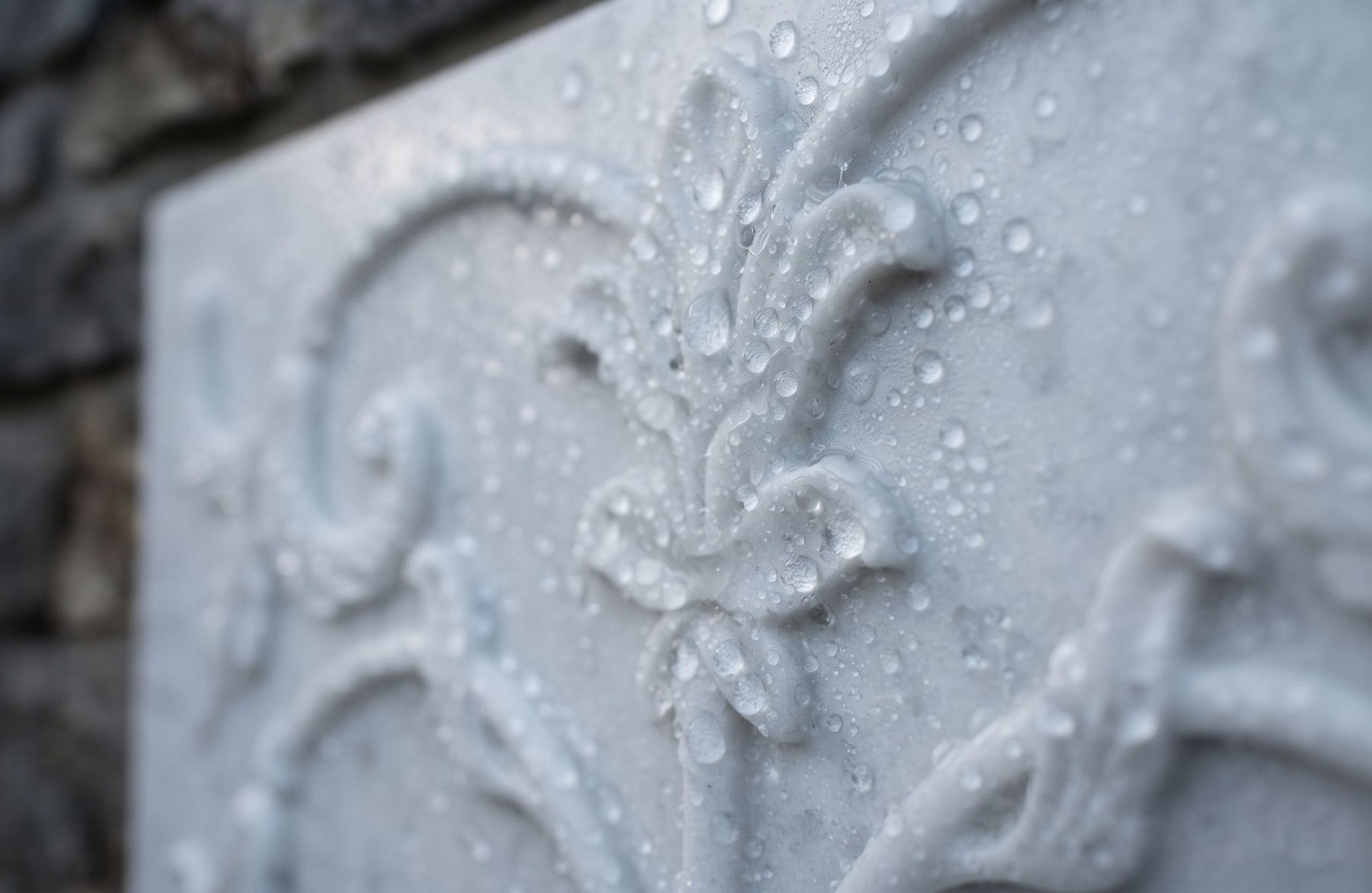
- Re-test over time. When water no longer beads on the surface, it is time to reapply. In practice this is every few years to once a decade, depending on exposure.
Cleaning carved stone
Gentle is the rule. Use clean water, a soft brush and a pH-neutral stone cleaner. Avoid acidic cleaners, which etch marble and limestone, and avoid pressure washing, which erodes fine carved detail. Algae and lichen are common in shaded, damp spots. Treat them with a biocidal wash made for natural stone, used strictly to the label, rather than scrubbing or using household bleach.
Bronze outdoors: a material that is meant to change
Bronze is one of the most durable materials a designer can specify. Its surface, however, is alive. Left alone outdoors, a warm brown finish will darken over the first seasons and, with moisture, pollution or salt air, move toward the greens and blue-greens of verdigris. That patina is protective, and many clients love it. The decision to make at specification is whether to let the bronze age freely, or to hold a chosen finish with regular care.
Holding a finish: wax, not lacquer
Where a particular colour is to be kept, the usual approach is a chemical patina sealed with a protective wax, renewed on a routine. Clear lacquers are sometimes applied, but outdoors they tend to break down, and a failing coating can look worse than bare bronze. Wax is easier to renew and to repair locally.
A simple care routine
- Rinse with clean water once or twice a year to remove dust and salts.
- Wash gently with a mild, non-ionic soap and a soft brush. Rinse and let the piece dry fully.
- Apply a thin coat of microcrystalline paste wax with a soft cloth, then buff.
- Repeat annually, and more often near the sea or in heavy traffic and pollution.
- Every few years, have the piece inspected, and the wax or patina refreshed by a professional where horizontal surfaces have worn.
What to avoid with bronze
- Pressure washers, abrasive pads and household or acidic cleaners.
- Irrigation sprinklers that spray the piece, as hard water leaves spots and streaks.
- Leaving bird droppings in place, which are acidic and can etch the surface.
Where bronze meets stone
Water running over bronze carries copper salts, which can leave green or brown staining on pale marble below. Detail for it: add a drip edge, shed water away from the stone, separate the two materials where they touch, or decide in advance that a soft green bloom is acceptable. Use stainless steel or bronze fixings with isolating washers, so that dissimilar metals do not corrode one another.
What to expect over 20 years
These are indicative guideposts for a well-detailed, regularly maintained installation in a temperate climate. Coastal, very cold and heavily polluted sites will need closer attention.
- Years 0 to 1. Sealer cures and bronze patina settles. Apply the first wax coat to the bronze. Polished marble begins to lose its gloss.
- Years 1 to 5. Marble reads as satin or matte. Light algae may appear in shade. Bronze darkens, and water run-off may leave faint streaks. Annual washing and waxing keeps these even.
- Years 5 to 10. Test the stone sealer by watching whether water beads, and reapply where needed. Inspect joints and fixings. Have bronze horizontals professionally re-waxed where the finish has worn.
- Years 10 to 20. Fine carved detail in softer stones may soften slightly. Re-seal, and re-point joints with a compatible material as required. Bronze develops a deeper, more even patina, with an occasional professional refresh.
At twenty years, a well-chosen and cared-for piece is structurally unchanged. What changes is its surface character: the stone becomes softer to the eye, and the bronze deeper in tone. Both are usually considered gains, provided the client expected them.
What to specify and hand over
- Name the finish for the exposure. Honed or textured stone, rather than polished, for open positions.
- Draw the drainage. Falls, drips, plinths and damp-proof breaks belong on the details, not left to site.
- Specify non-ferrous fixings and isolation between dissimilar metals.
- Decide the bronze strategy early: free patina, or held finish with a wax routine.
- Include a care note in the handover pack, with products, intervals and what to avoid, so the owner and the grounds team are not left to guess. We are glad to advise on a schedule suited to the piece and the site.
- Review a sample outdoors in the intended light and weather before committing to a large run.
Frequently asked questions
Will outdoor marble stay polished?
Not usually. A mirror polish typically relaxes to a satin or matte surface in the open air. A honed or textured finish is a better choice for exposed positions.
Does carved stone always need sealing?
No. Dense stone in a dry position may need little or none. Porous stone, or stone exposed to staining and constant damp, benefits from a breathable, penetrating sealer.
How often should bronze be waxed?
Once a year is a sound default, and more often near the sea or in high pollution.
Is it a problem if bronze turns green?
No. The green patina is protective. If the client prefers the original colour, a regular wax routine, and a chemical patina refreshed by a professional, can hold it.
Can I pressure-wash a carved piece?
We advise against it. Use clean water, a soft brush and a pH-neutral cleaner instead.
Continue reading
Planning a commission for an outdoor setting?
Share what you have in mind, and where it will stand. Begin a bespoke commission, or see the current pieces on Our Collections.